
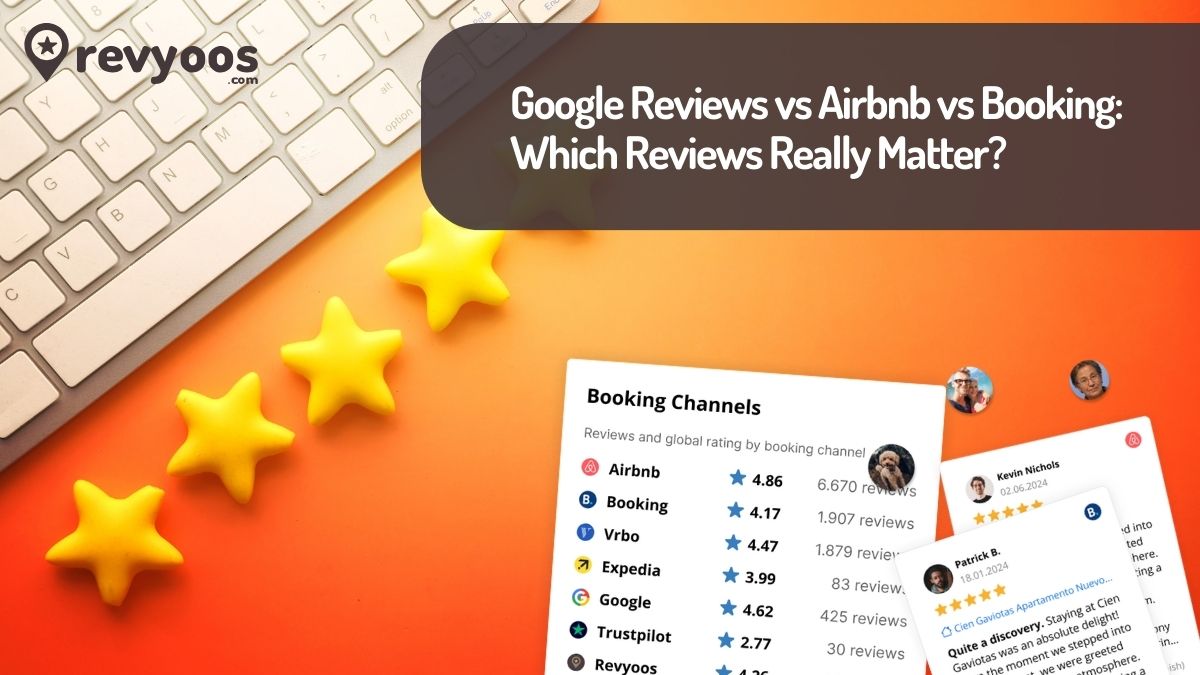
As a vacation rental property manager, you’re collecting reviews across multiple platforms—Airbnb, Booking.com, Vrbo, Google, TripAdvisor, and more. Each platform promises to showcase your guest feedback and build trust with potential bookers. But here’s the reality: not all reviews carry equal weight when travelers make their booking decisions.
Understanding which review platforms actually drive bookings can transform your reputation management strategy. Instead of spreading your efforts thin, you can focus on the channels that matter most to your target guests and maximize the return on every five-star experience you deliver.
- The Multi-Platform Review Reality for Vacation Rentals
- Google Reviews: The Trust Foundation for Vacation Rentals
- Airbnb Reviews: Platform-Specific Power
- Booking.com Reviews: The Hotel-Style Perspective
- Comparing Review Impact: What the Data Reveals
- The Multi-Channel Review Strategy That Actually Works
- Making Review Management Scalable
- The Direct Booking Advantage of Unified Reviews
- Platform-Specific Review Best Practices
- Measuring Review Impact on Revenue
- Common Review Management Mistakes to Avoid
- The Future of Vacation Rental Reviews
- Taking Control of Your Complete Review Profile
- Frequently Asked Questions
The Multi-Platform Review Reality for Vacation Rentals
Property managers today face a fragmented reputation landscape. Your reviews live in silos across platforms that rarely communicate with each other. A glowing five-star review on Airbnb doesn’t automatically appear on your Google Business Profile. That detailed testimonial from Booking.com remains invisible to direct booking visitors on your website.
According to Lodgify’s 2024 Vacation Rental Industry Report, which analyzed over 116,000 guest reviews, vacation rental managers are increasingly dealing with reviews spread across an average of 4-6 different platforms. This fragmentation creates three critical challenges: you lose control over your complete reputation story, potential guests only see partial feedback depending on where they search, and responding to reviews becomes a time-consuming task scattered across multiple dashboards.
The rise of Google Vacation Rentals has added another dimension to this complexity. The platform experienced 72% growth in booking volume in 2024, yet it aggregates reviews from various sources rather than hosting its own review system. This means travelers researching on Google see a composite picture of your reputation—but only if you’ve properly syndicated your reviews across the web.
Google Reviews: The Trust Foundation for Vacation Rentals
When travelers start their search for accommodation, 81% begin with Google rather than going directly to booking platforms. Your Google Business Profile and the reviews it contains serve as your digital storefront, often creating the crucial first impression that determines whether someone clicks through to learn more or scrolls past to your competitor.
Join 1,000+ property managers and hotels using Revyoos to increase direct bookings and automate review management.
Why Google Reviews Carry Unique Weight
Google reviews function differently from platform-specific feedback. According to research published by MARA Solutions analyzing hotel and vacation rental booking behavior, 81% of travelers always read reviews before booking accommodation, with 70.9% saying online reputation directly influences their choice. What makes Google reviews particularly influential is their perceived neutrality—they’re not tied to a specific booking platform’s ecosystem.
Think of it this way: an Airbnb review exists within Airbnb’s marketplace where the platform curates the experience. A Google review, however, appears across Google Search, Google Maps, and third-party websites that pull in your Google rating. This broader distribution amplifies your reputation beyond any single booking channel.
The SEO impact of Google reviews creates another compelling advantage. Properties with Google reviews and properly implemented rich snippets experience a 35% increase in click-through rates from search results, according to research from CXL. When your star rating appears directly in search results alongside your property name, you stand out visually from competitors who lack this social proof.
Google’s Growing Role in Vacation Rental Discovery
The introduction of Google Vacation Rentals has fundamentally shifted how travelers discover properties. Rather than starting their search on Airbnb or Booking.com, travelers now find vacation rentals directly through Google search results alongside hotels and traditional accommodation options.
Google Vacation Rentals doesn’t process bookings itself—instead, it aggregates listings from partner platforms and direct booking sites, then directs traffic to the property’s booking page. This creates an interesting dynamic: your reviews from other platforms may appear on Google, but your native Google reviews travel with you across the web, reinforcing your reputation regardless of which booking channel ultimately captures the reservation.
For property managers with direct booking websites, Google reviews serve as the primary trust signal that encourages visitors to book directly rather than returning to familiar OTA platforms. Since Google reviews aren’t tied to a specific booking platform, they carry particular credibility with travelers evaluating whether to book through your website or stick with the perceived safety of an established marketplace.
Airbnb Reviews: Platform-Specific Power
Airbnb’s review system operates within the world’s largest vacation rental marketplace, where platform-specific reviews directly influence your ranking, visibility, and Superhost status. With 46% of vacation rental bookings coming through Airbnb according to Lodgify’s 2024 report, these reviews carry tremendous weight—but primarily within Airbnb’s ecosystem.
The Airbnb Review Advantage
What makes Airbnb reviews particularly powerful is their verified booking requirement. Only guests who actually completed a stay can leave reviews, creating an authenticity factor that travelers trust. The two-way review system—where both guests and hosts review each other—adds another layer of accountability that reduces fraudulent or malicious feedback.
Airbnb reviews directly impact your search ranking within the platform. Properties with higher ratings and more reviews appear first in search results, while those with lower ratings or recent negative feedback slide down. For hosts dependent on Airbnb bookings, maintaining a strong review profile isn’t optional—it’s essential for visibility.
The detailed rating categories Airbnb introduced (cleanliness, accuracy, communication, location, check-in, value) provide granular feedback that helps potential guests make informed decisions. These subcategories also give you specific areas to focus your improvement efforts rather than generic “we need better reviews” directives.
The Airbnb Review Limitation
The significant limitation of Airbnb reviews is their platform confinement. An excellent 4.9-star rating on Airbnb with 200 reviews doesn’t transfer to Google, your direct booking site, or any other channel. When travelers discover your property outside of Airbnb—through Google search, social media, or direct marketing—those hard-earned reviews remain invisible.
Airbnb’s terms of service restrict how hosts can display Airbnb reviews on external websites. While you can mention your Superhost status or reference your rating in marketing materials, you cannot typically embed full Airbnb reviews on your direct booking website. This creates a credibility gap: travelers visiting your site see limited social proof even though you’ve accumulated hundreds of verified reviews on Airbnb.
The review response dynamics on Airbnb also differ from other platforms. While you can respond publicly to reviews, the format and visibility of responses vary, and the platform’s algorithm weighs various factors beyond just your review score when determining search ranking.
Booking.com Reviews: The Hotel-Style Perspective
Booking.com brings a hotel-industry approach to vacation rental reviews, with scoring systems and feedback categories that travelers from the traditional hospitality world find familiar. With an estimated 17 billion in revenue generated in 2022 through 895 million nights booked, Booking.com represents a significant booking channel for many vacation rental managers.
Booking.com’s Review Strengths
Booking.com’s 10-point scoring system provides numerical precision that some travelers prefer over star ratings. The platform displays separate scores for cleanliness, comfort, facilities, staff, value for money, and location—giving potential guests detailed insights into what they can expect.
The review verification process on Booking.com ensures that only actual guests who completed stays can submit feedback. This verification, combined with Booking.com’s requirement that reviews be submitted within specific timeframes after checkout, creates recency and authenticity that travelers value.
For property managers who list on Booking.com, these reviews can significantly impact booking conversion. The platform prominently displays review scores and highlights recent feedback on property listing pages, making reviews a central part of the booking decision process.
The Cross-Platform Visibility Challenge
Like Airbnb reviews, Booking.com feedback largely stays within Booking.com’s ecosystem. While Google Vacation Rentals may display some Booking.com review data when aggregating information, the reviews don’t automatically appear on your Google Business Profile, direct booking website, or other marketing channels.
Property managers often find themselves explaining to potential direct bookers that they have extensive positive reviews on Booking.com that aren’t visible on their website. This creates an unnecessary friction point in the booking process where travelers must take you at your word rather than seeing verified proof.
The review response culture on Booking.com also differs from other platforms. While you can respond to reviews, the platform’s interface and traveler expectations vary from the more conversational tone common on Airbnb or the SEO-optimized responses many properties craft for Google reviews.
Comparing Review Impact: What the Data Reveals
Research from TripAdvisor’s global study of 23,000 travelers provides insight into how reviews influence booking decisions. The study found that 81% of travelers always or frequently read reviews before booking accommodation, with travelers reading an average of 9 reviews before making their final decision.
Recency Trumps Volume
The TripAdvisor research revealed that 78% of travelers focus on the most recent reviews rather than overall volume or lifetime ratings. This finding has important implications for vacation rental managers: accumulating hundreds of older reviews matters less than maintaining a steady flow of recent positive feedback.
A property with 50 reviews averaging 4.8 stars, with 10 reviews from the past month, will often outperform a property with 300 reviews averaging 4.9 stars if those reviews are spread over three years with little recent activity. Travelers want current information that reflects the property’s present condition and management standards.
This recency preference varies slightly by platform. Google reviews display publication dates prominently and allow travelers to sort by “newest,” making recency particularly visible. Airbnb’s algorithm also weighs recent reviews more heavily in search ranking, while Booking.com displays a rolling average that can sometimes obscure whether feedback is current or outdated.
Negative Reviews Have Disproportionate Impact
Research from Harvard Business School analyzing thousands of hotel and vacation rental bookings found that negative reviews carry significantly more weight than positive ones when travelers make booking decisions. A single negative review can cost a business up to 30 potential customers, while it typically takes 3-5 positive reviews to counterbalance the trust damage from one negative review.
This asymmetry creates particular challenges across platforms. A negative review on Google—your most publicly visible channel—can deter potential bookers before they ever explore your Airbnb profile with its 4.9-star rating. Conversely, a problematic review buried in your Booking.com history might seem insignificant until a traveler specifically asks about it during the booking inquiry process.
The way you respond to negative reviews matters enormously. According to MARA Solutions’ research on review response effectiveness, 56% of customers change their opinion about a business upon reading the company’s responses to reviews. A thoughtful, professional response to criticism can actually build more trust than a perfect review history.
The Multi-Channel Review Strategy That Actually Works
Smart property managers don’t choose between Google, Airbnb, and Booking.com reviews—they develop a cohesive strategy that leverages the strengths of each platform while addressing their limitations.
Start with Google as Your Foundation
Every vacation rental should prioritize building their Google Business Profile review collection. These reviews provide the broadest reach, the strongest SEO benefits, and serve as your reputation foundation for travelers who discover you outside of OTA platforms.
For direct booking success, Google reviews are non-negotiable. When travelers land on your website after searching for vacation rentals in your area, they’re looking for trust signals. Your Google rating visible in search results and your Business Profile review count provide that crucial credibility before they even click through to your site.
The practical challenge comes in actually collecting Google reviews from guests. Unlike Airbnb and Booking.com, which automatically prompt guests to review after checkout, Google requires you to proactively request reviews. According to BrightLocal’s 2024 Local Consumer Review Survey, the percentage of consumers who always leave a review when prompted increased from 12% in 2023 to 19% in 2024, with 69% of consumers recalling leaving a business review after being prompted within the past year.
Maintain Strong Platform-Specific Profiles
Your Airbnb and Booking.com reviews remain critical for visibility and conversion within those platforms. Neglecting platform-specific review collection because you’re focused on Google would be a costly mistake, given that OTAs still account for 65% of vacation rental bookings.
The key is creating review request systems that work across platforms. After a guest checks out from an Airbnb booking, your primary goal is securing that Airbnb review since it directly impacts your platform ranking. For direct bookings, Google reviews take priority since they benefit your broader online presence.
Some property managers implement a staged approach: request a platform review immediately after checkout (Airbnb or Booking.com for OTA bookings), then follow up 5-7 days later with a request for a Google review, mentioning that you’d appreciate their support in helping other travelers discover your property.
Aggregate and Display All Reviews
The solution to the platform fragmentation problem is review aggregation. Rather than accepting that your reviews remain scattered across disconnected platforms, consolidate them into a unified display that appears on your direct booking website and marketing materials.
Revyoos specializes in exactly this challenge—automatically collecting reviews from Airbnb, Booking.com, Vrbo, Expedia, TripAdvisor, Google, and Trustpilot, then providing customizable widgets that display your complete review history on your website. This approach transforms scattered platform reviews into comprehensive social proof that builds trust with potential direct bookers.
The SEO benefits of aggregated reviews extend beyond just displaying testimonials. Properly implemented review schema markup—which Revyoos handles automatically—enables rich snippets in Google search results. These enhanced listings display your star rating and review count directly in search results, creating visual prominence that increases click-through rates by an average of 35%, according to CXL research.
Making Review Management Scalable
Most property managers struggle with review management because the manual effort doesn’t scale. Logging into multiple platforms daily to check for new reviews, crafting individual responses, and tracking your review metrics across channels consumes hours each week—time that could be spent on revenue-generating activities.
Automate Review Collection
Implementing automated review requests immediately after checkout significantly increases your review volume across all platforms. The key is timing: guests are most likely to leave reviews within 24-48 hours of checkout when their experience remains fresh in their minds.
For platform bookings, leverage each platform’s built-in review request system. Airbnb and Booking.com automatically prompt guests to review, but sending a personal follow-up message expressing appreciation for their stay and subtly mentioning that you’d love their feedback can boost response rates.
For direct bookings, create an automated email sequence that sends a thank-you message on checkout day, followed by a review request with direct links to your Google Business Profile 2-3 days later. According to Revyoos’ research on review collection timing, this brief delay increases review submission rates compared to same-day requests, likely because guests need time to reflect on their overall experience.
Centralize Review Monitoring
Checking five different platforms daily for new reviews creates unnecessary friction in your workflow. Centralized review management through Revyoos consolidates all your reviews into a single dashboard where you can monitor new feedback, respond efficiently, and track your reputation trends across platforms.
This centralization matters beyond just convenience. When you can see your complete review landscape in one view, patterns become visible that remain hidden when reviews are scattered. You might notice that guests consistently praise your kitchen amenities on Airbnb while Google reviews emphasize your location—insights that should inform your marketing messaging across channels.
The response efficiency gains from centralized monitoring are substantial. Rather than logging into Airbnb, then Booking.com, then Google Business Profile to check for and respond to reviews, you handle everything from one interface. For property managers with multiple listings, this consolidation can save 5-10 hours per week.
Create Response Templates That Feel Personal
Responding to every review builds trust with both the reviewer and future guests reading your responses. Research shows that 62% of travelers are more likely to book a property if they see that management responds to reviews.
The challenge is responding thoughtfully without spending an hour crafting unique replies to every piece of feedback. The solution is developing flexible response templates organized by review type and sentiment, then personalizing specific details for each reply.
For positive reviews, your response template might follow this structure: thank the guest by name, reference a specific detail they mentioned in their review, express appreciation for their feedback, and invite them to return. For example: “Thank you, Sarah! We’re thrilled you enjoyed the rooftop deck—it really is the perfect spot for morning coffee. We appreciate you taking time to share your experience and would love to host you again on your next visit to Austin.”
For negative reviews, your template should acknowledge the issue, explain any context if appropriate, describe what you’ve done to address the problem, and offer to discuss further offline. The key is responding promptly (ideally within 24 hours) and maintaining a professional, solution-focused tone rather than becoming defensive.
The Direct Booking Advantage of Unified Reviews
Property managers increasingly recognize that over-dependence on OTAs erodes profitability. With commission rates ranging from 15-25%, every booking through an OTA costs significantly more than capturing that reservation directly through your website.
Reviews play a crucial role in direct booking success, but only if potential guests can actually see them. When travelers visit your website after discovering you through Google search or social media, they need immediate trust signals. A direct booking site that lacks visible reviews—or displays only a handful of recent testimonials—creates doubt that sends potential guests back to the perceived safety of Airbnb or Booking.com.
According to Lodgify’s 2024 report analyzing over one million bookings, direct booking sites accounted for 34% of vacation rental bookings in 2024, second only to Airbnb’s 46%. This represents significant growth in direct bookings, but conversion rates remain the challenge. Property managers report that driving traffic to their direct booking sites is easier than converting those visitors into actual bookings.
Displaying your aggregated reviews from all platforms on your direct booking website addresses this conversion challenge directly. When a traveler who found you through a Google search sees 200+ verified reviews from Airbnb, Booking.com, Google, and TripAdvisor all displayed together on your site, it provides the social proof necessary to book with confidence—even though they’re booking outside the familiar OTA ecosystem.
The review widget implementation matters significantly. Simply pasting a few testimonials on your “Reviews” page provides minimal impact. Instead, strategically place review displays throughout your booking funnel: abbreviated review counts and ratings on your homepage, category-specific reviews (cleanliness, location, amenities) on property description pages, and a comprehensive review section with filtering options accessible from your main navigation.
Revyoos provides customizable widgets that integrate seamlessly with popular vacation rental websites, displaying real-time review feeds from all your platforms without requiring technical expertise. The widgets include filtering options so visitors can view reviews from specific sources, sort by date or rating, and see your average ratings across different categories.
Platform-Specific Review Best Practices
While a unified review strategy provides the foundation, each platform has unique characteristics that require tailored approaches to maximize review collection and impact.
Google Review Optimization
Google reviews benefit from keyword-rich responses that support your local SEO efforts. When guests mention specific amenities, nearby attractions, or property features in their reviews, their natural language incorporates valuable search terms that strengthen your ranking for related queries.
Responding to Google reviews provides an opportunity to reinforce these keywords while providing helpful information for future guests. For example, if a guest writes “The downtown location was perfect for walking to restaurants,” your response might acknowledge “We’re glad our central downtown location made it easy for you to explore all the amazing restaurants within walking distance. It’s one of the features our guests appreciate most.”
Encourage guests to include photos in their Google reviews. Visual content makes your review profile more engaging and provides authentic social proof that professionally staged marketing photos can’t match. Reviews with photos receive significantly more engagement and are viewed as more trustworthy by potential guests.
Airbnb Review Strategy
Airbnb’s simultaneous review system—where both parties must submit reviews within 14 days, but neither sees the other’s review until both submit—creates strategic considerations. The time pressure to submit reviews before the deadline sometimes results in rushed, generic feedback rather than thoughtful detailed reviews.
To encourage detailed Airbnb reviews, consider sending a mid-stay check-in message asking if everything is meeting expectations. This proactive approach allows you to address any issues during the stay and demonstrates attentiveness that guests often mention in their reviews. A guest who experienced responsive service when their request was addressed is more likely to leave a positive detailed review than a guest who had a perfectly adequate but unremarkable stay.
The two-way review dynamic also means you should develop a fair but positive review style for guests. Overly negative guest reviews can create hesitation among future potential guests about your hospitality approach, even though you’re reviewing them rather than them reviewing you. Focus on objective facts in guest reviews and save detailed critical feedback for private communication.
Booking.com Review Management
Booking.com’s review system allows properties to respond to reviews and also enables the platform to showcase properties that respond frequently to guest feedback. Make responding to every Booking.com review a priority, as your response rate becomes visible to potential guests and influences their booking confidence.
The platform’s numerical scoring across categories provides specific feedback about where your property excels or needs improvement. Track these category scores over time to identify trends. If your “Value for Money” score drops while other categories remain strong, it may indicate that your pricing has become misaligned with guest expectations relative to what you deliver.
Booking.com also allows properties to request review content removal if it violates the platform’s guidelines. While you shouldn’t abuse this feature, legitimate violations—such as reviews that mention other properties, contain personal attacks, or violate Booking.com’s content policy—should be flagged for review. Even one inappropriate review that remains visible can damage your reputation unnecessarily.
Measuring Review Impact on Revenue
Property managers should track review metrics the same way they monitor occupancy rates and ADR. The correlation between review performance and booking revenue is substantial but varies by platform and property type.
Research from STR (formerly Smith Travel Research) analyzing thousands of vacation rental properties found a clear relationship between review scores and pricing power. Properties with ratings above 4.5 stars commanded ADRs 15-20% higher than comparable properties with ratings between 4.0-4.5 stars. Below 4.0 stars, properties experienced significant difficulty maintaining occupancy at any price point.
The revenue impact of reviews extends beyond just room rates. Properties with strong review profiles across multiple platforms report booking windows that are 25-30% longer than properties with limited reviews. This extended booking lead time allows for better revenue management, reduces last-minute discounting, and provides stability in cash flow forecasting.
Track these key review metrics monthly:
- Average rating across each platform (Google, Airbnb, Booking.com)
- Total review count and monthly review acquisition rate
- Response rate to reviews (target 100% within 48 hours)
- Review sentiment analysis (percentage positive, neutral, negative)
- Common themes in feedback (extracted through keyword analysis)
- Correlation between review score and booking conversion rate
Many property managers discover that review performance predicts revenue changes with a 30-60 day lag. When review metrics improve, booking inquiries typically increase 4-6 weeks later as those improved reviews accumulate and begin influencing search rankings and traveler perceptions.
Common Review Management Mistakes to Avoid
Even experienced property managers fall into review management traps that undermine their reputation and revenue potential.
Ignoring Negative Reviews
The instinct to avoid engaging with negative feedback is strong, but silence in response to criticism creates a worse impression than the negative review itself. Potential guests reading your reviews interpret non-response as indifference or an acknowledgment that the criticism is valid.
Always respond to negative reviews professionally and constructively. Acknowledge the guest’s disappointment, explain your perspective if relevant (without making excuses), describe what you’ve done to address the issue, and offer to discuss further offline. This response demonstrates to future guests that you care about guest experiences and take feedback seriously.
Some property managers make the mistake of responding defensively to negative reviews, arguing with the guest or questioning their motives. This approach destroys trust far more effectively than the negative review itself. Future guests don’t expect perfection—they expect professional, responsive management when issues arise.
Review Gating (Selective Review Requests)
Some property managers implement “review gating”—only requesting reviews from guests they believe had positive experiences while ignoring potentially negative reviewers. This practice violates most platform policies and creates legal exposure in some jurisdictions.
Beyond the compliance issues, review gating produces an artificially inflated review profile that sophisticated travelers recognize as suspicious. Properties with exclusively five-star reviews raise red flags. According to research from Revyoos’ blog analyzing guest booking behavior, a mix of positive ratings with occasional lower-rated reviews generates greater credibility than a perfect but implausible review history.
Request reviews from all guests consistently, regardless of how you believe their experience went. You might be surprised—guests you thought were unhappy sometimes leave positive reviews, while guests who seemed satisfied might have constructive feedback you need to hear.
Platform Bias
Some property managers focus exclusively on one platform’s reviews while neglecting others. An Airbnb-dependent manager might have 300 Airbnb reviews but only 5 Google reviews, creating a credibility gap for travelers who discover the property outside Airbnb.
Maintain balanced review collection across all platforms where you maintain a presence. If you list on Airbnb, Booking.com, and Vrbo, and also encourage direct bookings through your website, you should be actively collecting reviews for all channels. This balanced approach ensures that travelers find credible social proof regardless of where they discover your property.
The exception is platforms where you have minimal booking activity. If you receive only 2-3 bookings per year from a particular OTA, investing significant effort in building that platform’s review profile provides minimal return. Focus your energy on platforms that drive meaningful booking volume.
The Future of Vacation Rental Reviews
The review landscape continues evolving, with several trends reshaping how travelers evaluate properties and make booking decisions.
AI-Powered Review Analysis
Artificial intelligence tools now analyze review content to extract themes, sentiment, and actionable insights at scale. Rather than manually reading hundreds of reviews to identify recurring praise or complaints, AI systems can process your entire review history and surface patterns that inform operational improvements.
Revyoos recently launched sentiment analysis powered by AI that automatically categorizes reviews by emotional tone and extracts key topics guests mention most frequently. This technology allows property managers to identify issues before they become patterns and double down on amenities and services guests consistently praise.
The next evolution in AI review tools involves predictive analytics—identifying which specific operational changes are most likely to improve review scores based on your property’s unique characteristics and guest feedback patterns. These recommendations move beyond generic advice to actionable, data-driven improvements tailored to your specific review history.
Video and Visual Review Content
Static text reviews, while valuable, are increasingly supplemented by visual content. Google encourages reviewers to include photos, and platforms like Instagram and TikTok influence how travelers research and share their experiences.
Property managers should encourage guests to include photos in their reviews, particularly on Google where visual content significantly increases review engagement. Some managers create photo-worthy moments throughout their properties—artistic wall features, unique amenities, stunning views—specifically designed to inspire guest photography that translates into compelling review content.
The challenge with visual review content is maintaining control over what gets shared. Guests photograph and video everything, including any property deficiencies or outdated features you’d prefer remained unphotographed. This reality makes property maintenance and regular updates even more critical, as declining property standards become immediately visible in guest-generated content.
Cross-Platform Review Verification
As fake reviews remain a concern across all industries, verification systems that confirm reviewers actually stayed at properties gain importance. Platforms that can prove review authenticity will command greater trust from travelers.
Google, Airbnb, and Booking.com already implement verification—reviews can only come from confirmed guests. The emerging trend is cross-platform verification, where a review from any platform carries a verified badge that follows it across the web. This development would significantly benefit review aggregation tools, as aggregated reviews could maintain their verified status even when displayed outside their original platform.
Taking Control of Your Complete Review Profile
The question isn’t whether Google reviews, Airbnb reviews, or Booking.com reviews matter most—it’s how you create a cohesive review strategy that leverages each platform’s strengths while compensating for their limitations.
Smart property managers recognize that review fragmentation is the real challenge. Your reputation exists across multiple platforms, but potential guests only see partial pictures depending on where they encounter your property. The solution is aggregating, displaying, and managing all your reviews through a unified system that presents your complete reputation story regardless of where travelers find you.
Revyoos provides exactly this solution, automatically collecting reviews from all major platforms, providing centralized monitoring and response tools, and creating customizable widgets that display your aggregated reviews on your direct booking website. This approach transforms scattered platform reviews into comprehensive social proof that builds trust and drives conversion.
The vacation rental managers who succeed in 2025 and beyond won’t be those who pick a single review platform and hope for the best. They’ll be the managers who understand that every review matters, every platform serves a purpose, and presenting a unified, comprehensive reputation across channels is what separates adequate performance from exceptional results.
Frequently Asked Questions
1. Do Google reviews or Airbnb reviews matter more for vacation rentals?
Both matter significantly, but serve different purposes. Google reviews provide the broadest reach and support SEO, making them critical for direct bookings and travelers who discover you through search. Airbnb reviews directly impact your visibility and ranking within Airbnb’s platform, which accounts for approximately 46% of vacation rental bookings. The ideal strategy prioritizes building strong review profiles on both platforms rather than choosing between them.
2. Can I display my Airbnb reviews on my direct booking website?
Airbnb’s terms of service restrict displaying full Airbnb reviews on external websites. While you can mention your Superhost status or reference your rating in marketing materials, embedding actual review content typically violates platform policies. The solution is using a review aggregation platform like Revyoos that collects and displays reviews from all your platforms in compliance with each platform’s terms of service.
3. How many reviews do I need to build trust with potential guests?
Research shows that travelers read an average of 9 reviews before making booking decisions, with 78% focusing on the most recent feedback. The optimal review count varies by property type and market, but properties with 20+ recent reviews (posted within the past year) demonstrate sufficient credibility for most travelers. However, review recency and quality matter more than absolute volume—50 recent reviews outperform 200 old reviews.
4. Should I respond to all reviews or just negative ones?
Respond to every review, positive and negative. Research from MARA Solutions found that 62% of travelers are more likely to book properties where management responds to reviews, and 56% of customers change their opinion about a business after reading responses. Responding to positive reviews shows appreciation and reinforces what you do well, while responding to negative reviews demonstrates professionalism and problem-solving commitment.
5. How do reviews on different platforms affect my Google ranking?
While reviews on Airbnb and Booking.com don’t directly transfer to your Google Business Profile, they can influence your overall online presence. Google Vacation Rentals may aggregate review data from various platforms, and the authority signals from strong profiles across multiple platforms can indirectly support your SEO. However, native Google reviews provide the most direct impact on local search ranking and the rich snippets that appear in search results.
6. What’s the best timing to request reviews from guests?
For platform bookings (Airbnb, Booking.com), leverage the automatic review prompts those platforms send immediately after checkout. For direct bookings, send a thank-you message on checkout day, then follow up with a specific review request 2-3 days later when guests have had time to reflect on their experience. According to BrightLocal’s 2024 research, 69% of consumers who were prompted left a review within the past year, with response rates highest when requests are personalized and include direct links to the review platform.
7. How do I handle fake or unfair reviews?
Each platform has policies and processes for disputing reviews that violate their guidelines. Google, Airbnb, and Booking.com will remove reviews that contain personal attacks, violate policies, or are demonstrably false. However, threshold for removal is high—platforms generally don’t remove negative reviews just because you disagree with the guest’s perspective. Focus on crafting professional public responses that provide your perspective and demonstrate your commitment to guest satisfaction. Often, how you respond to criticism builds more trust than trying to remove the negative review.
Ready to take control of your vacation rental reviews across all platforms? Explore how Revyoos aggregates and displays your reviews from Airbnb, Booking.com, Google, TripAdvisor, and more to build the credible, comprehensive online presence that converts browsers into bookers. Start your free 14-day trial today—no credit card required.